
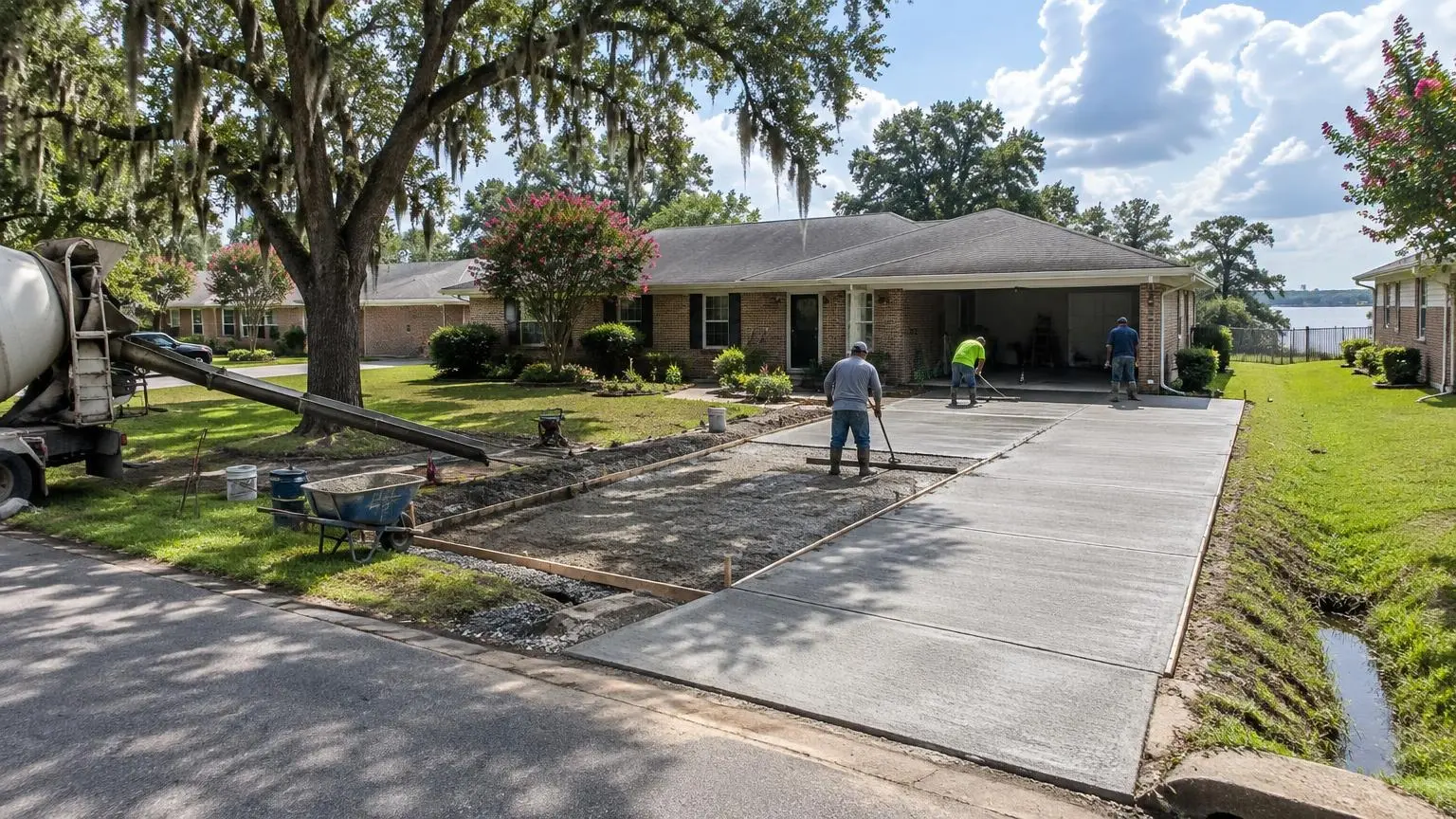
Flatwork for clay soil and heavy rain
Concrete Contractors in Baton Rouge, LA
Driveways, patios, slabs and walks set on a firm base and graded to shed Louisiana rain, priced in writing.
- Free measuring visit at your property
- Written quote with each line priced
- Grade and drainage planned before forms go in
Concrete Built for Baton Rouge Ground
Concrete Contractors Baton Rouge builds and repairs driveways, patios, stamped surfaces, slabs, walkways and steps for homeowners in Baton Rouge, Louisiana. Concrete here does not usually fail from frost. Wikipedia's climate table puts the average January low at 41.6 degrees. It fails from water and moving ground. The city averages 61.94 inches of rain a year, much of the soil under local lots is clay that swells and shrinks, and in a handful of neighborhoods an active fault is slowly cracking pavement. Residential concrete contractors in Baton Rouge have to plan for all three before the first truck arrives.
Three things that break slabs here
Rain and runoff. A summer storm can drop a lot of water in a short time. When that water runs off a roof or a neighbor's yard and soaks the soil along a slab's edge, the ground underneath softens. Fill washes out, edges lose support, and corners crack off. Most failing driveways in this city broke from below, not from the top.
Clay that moves. A 2021 study of expansive soils in Louisiana, published in Frontiers in Built Environment, lists Baton Rouge among the southern urban centers where the largest estimated property losses from swelling soil are concentrated. The authors note that these soils crack foundations, streets, driveways and sidewalks. Clay swells in a wet spring, shrinks in a dry August, and a thin slab on an unprepared base rides up and down with it.
Heat on pour day. The July average high is 91.9 degrees. Fresh concrete that dries too fast in sun and wind loses strength and crazes on the surface. Summer pours here start early in the morning, and the slab is kept damp or sealed with a curing compound while it gains strength.
The Baton Rouge fault
Few cities have a geologic fault running through their neighborhoods, and Baton Rouge has two active ones. WAFB reported that the Baton Rouge fault runs beneath College Drive about a block north of Corporate Boulevard, where there is a noticeable rise in the road. A 1981 fault damage study mapped 139 damaged buildings and houses along the fault line, with areas including Jefferson Place, Hillside near City Park Lake, Walnut Hills, Wells Place, College Drive Heights, Westminster and Tiger Bend Road. It found that cracks in streets, driveways, patios and sidewalks follow the fault's trend, and it estimated movement of a few inches per decade.
No slab can stop that kind of ground movement. If your home is near the fault, we place joints and reinforcement so cracking stays in straight, planned lines, and we will tell you plainly when patching a recurring crack makes more sense than tearing out sound concrete.
A city of 1960s and 1970s slabs
Point2Homes, summarizing Census survey data, gives 1976 as the median year Baton Rouge homes were built. Nearly half of the housing (46.8 percent) went up between 1950 and 1979, and 54.7 percent of homes are single-family detached houses. That means a lot of original driveways, carport slabs, stoops and front walks that are now 45 to 75 years old. Many were poured on thin bases with little reinforcement, and decades of live oak roots, clay movement and runoff have tilted panels and opened cracks. In newer subdivisions, original driveways often show settling first at the garage door and along the edges where the lawn meets the slab.
Drainage after 2016
The August 2016 flood put drainage on every homeowner's mind. Wikipedia's account of the 2016 Louisiana floods records more than 20 inches of rain in several parishes, 31.39 inches at Watson northeast of the city, and record crests on the Amite and Comite rivers. A new driveway or patio is one of the largest hard surfaces on a lot, so we decide where its water will go before the forms are set: toward the street or ditch, away from the foundation, and never into the path your yard already uses to drain.
Permits in East Baton Rouge Parish
The City-Parish residential permits page lists the addition to or expansion of a driveway, any accessory structure over 200 square feet, and patio cover installation among the typical situations that require a permit. Applications go through the MGO Connect portal, and the City-Parish number is 225-389-3000. Work in Livingston or Ascension Parish follows those parishes' rules. We check what your address needs and build it into the schedule.
What we pour and fix
- Driveways: replacements, widening, parking pads and new approaches.
- Patios: back patios, covered patio slabs and patio extensions.
- Stamped concrete: slate, stone, brick and wood-plank patterns in color.
- Slabs: garage and shop floors, shed and carport slabs, generator and AC pads.
- Sidewalks and steps: front walks, side paths, stoops and poured steps.
- Repair: lifting sunken panels, crack repair, resurfacing and panel replacement.
How a job runs
Measuring visit. We walk the area with you, measure, check how water moves across the lot, and note what affects price: tear-out, roots, soft spots and truck access.
Written quote. Every item on its own line, with any repair option priced next to replacement.
Prep. Old concrete out, soft soil removed, base placed and compacted, forms set to grade.
Pour. Reinforcement, concrete, finish and joints, timed around the forecast and the heat.
Handoff. HomeGuide's driveway guide says foot traffic is fine after 24 to 48 hours, cars should wait at least 7 days, and heavy vehicles should wait the full 30-day cure. We give you dates for your slab in writing.
Planning around the weather
With mild winters, concrete can be poured here in every month of the year. The real scheduling problem is rain. A pour needs a dry window for the base and the first hours of finishing, so we watch the forecast closely and will move a date rather than pour into a storm. If you are planning a patio for spring or a driveway before the holidays, call (225) 239-2979 early so the visit, quote and any permit are done before the weather turns.
Common Questions
What do concrete contractors charge per hour?
Most residential concrete work is priced by the job or the square foot, not by the hour, because materials, base work and finish make up much of the cost. For a sense of scale, HomeGuide lists standard concrete driveways at $6 to $10 a square foot installed. Your written estimate after we measure is the actual price.
What is the average cost of concrete per square foot in Louisiana?
HomeGuide's national guides list a 4-inch slab at $6 to $8 per square foot installed, standard driveways at $6 to $10, and plain patios at $4 to $12. Those are national averages; the guides give no Louisiana-only figure. Tear-out, base work, thickness and finish move the number, so a measured quote is the only reliable price.
How do I hire a concrete contractor in Baton Rouge?
Get two or three written bids and compare what is in them: slab thickness, base material and depth, reinforcement, joint spacing, drainage plan, permit and cleanup. Louisiana's State Licensing Board for Contractors runs a public Contractor Search, and its site lists a home improvement license category for residential projects of $7,500 or more, so look up anyone you are considering. Ask each bidder why your old concrete failed; a clear answer is a good sign.
Do you take small concrete jobs?
Yes. A generator pad, an AC pad, a short walk, a few steps or one replaced driveway panel all get the same measuring visit and written quote. Small jobs usually carry a minimum charge because the crew, forms and truck cost the same to bring out, and we tell you that number up front.
Should I buy ready-mix concrete myself?
For a small pad you mix by hand, maybe. For a driveway or patio, the concrete has to be ordered for the right strength, delivered on schedule and placed and finished within a short window, especially in summer heat. We order the ready-mix for each job so the mix, the timing and the crew line up.
Why does concrete crack so much in Baton Rouge?
Usually because of what is underneath. Clay soil swells and shrinks with the weather, heavy rain softens poorly drained ground, live oak roots lift walks and drives, and near the Baton Rouge fault the ground itself is slowly shifting. A firm base, proper slope and planned joints control most of it.
Do I need a permit for a new driveway in Baton Rouge?
The City-Parish residential permits page lists the addition to or expansion of a driveway as work that requires a permit. Applications go through MGO Connect, and the City-Parish line is 225-389-3000. We confirm the requirements for your address before scheduling.
When can I drive on new concrete?
HomeGuide's driveway guide says to wait at least 7 days for cars and the full 30 days for heavy vehicles, with foot traffic fine after 24 to 48 hours. We give you dates based on your mix and that week's weather.
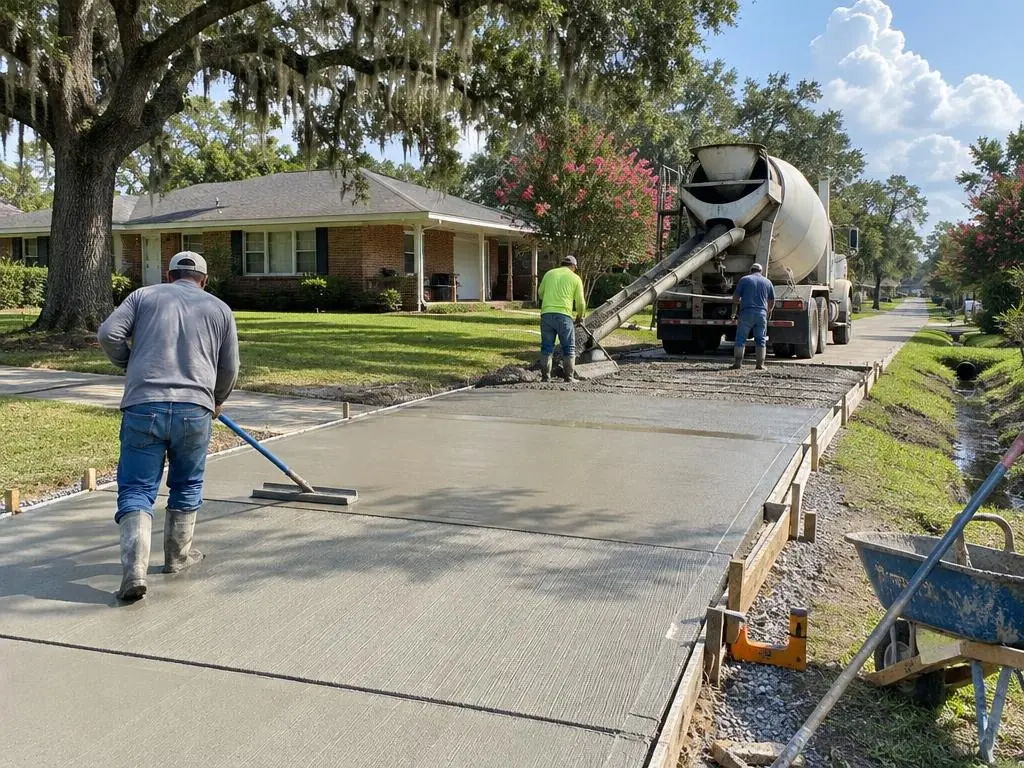
Our Concrete Services
Six kinds of residential concrete work, each planned around Baton Rouge rain, clay and heat.
Concrete Driveways
Driveway replacements, widening and parking pads on a compacted base, graded so storm water runs to the street, not under the slab.
Learn more →Concrete Patios
Back patios, covered patio slabs and extensions in broom, colored or exposed-aggregate finishes, pitched to drain away from the house.
Learn more →Stamped Concrete
Patios, entries, walks and pool decks pressed and colored to look like slate, stone, brick or wood plank, then sealed.
Learn more →Concrete Slabs
Garage and shop floors, shed and carport slabs, and generator and AC pads, set on a compacted base at the right thickness.
Learn more →Sidewalks & Steps
Front walks, side paths, stoops and poured steps rebuilt level, with roots and runoff dealt with so they stay that way.
Learn more →Concrete Repair
Lifting sunken panels, sealing and repairing cracks, resurfacing worn tops and replacing broken sections, priced against full replacement.
Learn more →Where We Work
Most of our work is inside Baton Rouge, from the older neighborhoods around LSU, the Garden District and Mid City to the subdivisions off Airline Highway, Jones Creek and Highland Road. We also work in the larger towns around the city: St. George to the southeast, Central and Baker to the north, Zachary farther up, Shenandoah to the southeast, Prairieville and Gonzales in Ascension Parish, Denham Springs and Walker across the Amite in Livingston Parish, and Port Allen across the river. Each place has its own permit office and its own drainage picture, and the 2016 flood hit some of them much harder than others. Each town page covers what we found about local housing, ground and rules.
- Concrete Contractors in Baton Rouge, LA
- Concrete Contractors in St. George, LA
- Concrete Contractors in Central, LA
- Concrete Contractors in Zachary, LA
- Concrete Contractors in Baker, LA
- Concrete Contractors in Denham Springs, LA
- Concrete Contractors in Walker, LA
- Concrete Contractors in Prairieville, LA
- Concrete Contractors in Gonzales, LA
- Concrete Contractors in Port Allen, LA
- Concrete Contractors in Plaquemine, LA
- Concrete Contractors in Brusly, LA
- Concrete Contractors in Addis, LA
- Concrete Contractors in Merrydale, LA
- Concrete Contractors in Brownfields, LA
- Concrete Contractors in Gardere, LA
- Concrete Contractors in Monticello, LA
- Concrete Contractors in St. Gabriel, LA
- Concrete Contractors in Livingston, LA
- Concrete Contractors in Watson, LA
- Concrete Contractors in Sorrento, LA
- Concrete Contractors in Slaughter, LA
- Concrete Contractors in Pride, LA
- Concrete Contractors in French Settlement, LA
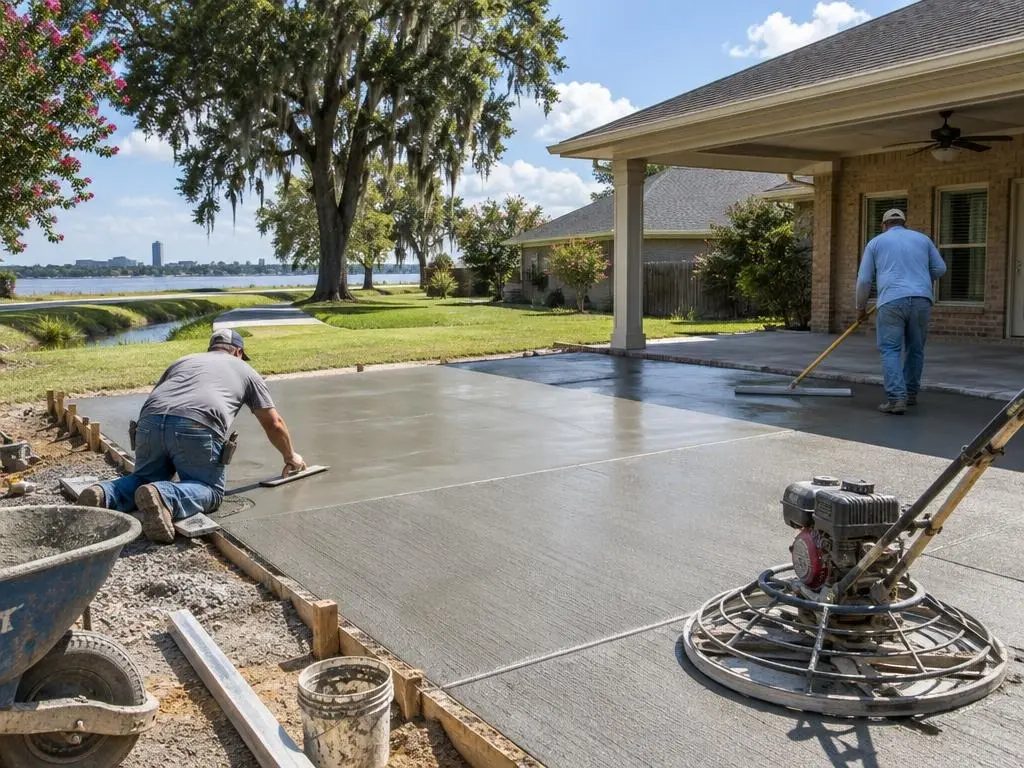
Why Homeowners Call Concrete Contractors Baton Rouge
Drainage comes first
Slope, downspouts and runoff paths are settled before any forms are set.
Base built for clay
Soft soil is dug out and a compacted base goes down, so the slab is not riding on mud.
Itemized pricing
Tear-out, base, thickness, steel and finish priced separately, so bids compare line by line.
Honest about repair
Lifting, crack repair or resurfacing is quoted when it will do the job, not only a tear-out.
Get a Free Concrete Estimate in Baton Rouge
We measure on site and price the job in writing, anywhere in Baton Rouge and the nearby Capital Region towns.